PRODUCT DESIGNER
Making hidden platform value visible at scale at Optum
As the platform scaled, value became harder to see and work increasingly duplicated. This project focused on making platform work visible—so teams could build with awareness, leaders could see progress, and clients could understand what they were buying.

PRODUCT DESIGNER
Making hidden platform value visible at scale at Optum
As the platform scaled, value became harder to see and work increasingly duplicated. This project focused on making platform work visible—so teams could build with awareness, leaders could see progress, and clients could understand what they were buying.
PRODUCT DESIGNER
Making hidden platform value visible at scale at Optum
As the platform scaled, value became harder to see and work increasingly duplicated. This project focused on making platform work visible—so teams could build with awareness, leaders could see progress, and clients could understand what they were buying.
THE PROBLEM
Context
Context
As OCM scaled, information about products, microproducts, and integrations was scattered across slide decks, SharePoint folders, and individual team knowledge. Teams proposed new builds without realizing similar capabilities already existed, ownership was unclear and delayed integration planning, leaders relied on manual updates to understand progress, and clients experienced the platform as a set of disconnected tools rather than a cohesive system.
As OCM scaled, information about products, microproducts, and integrations was scattered across slide decks, SharePoint folders, and individual team knowledge. Teams proposed new builds without realizing similar capabilities already existed, ownership was unclear and delayed integration planning, leaders relied on manual updates to understand progress, and clients experienced the platform as a set of disconnected tools rather than a cohesive system.

PRODUCT OWNER
“We often don't know what already existed, so teams ended up rebuilding the same things.”

BUSINESS LEADER
“We're lacking a clear, high-level view of what the platform is delivering.”

HOSPITAL ADMINISTRATOR
“We're struggling to understand what we are actually getting from the platform.”


THE RESEARCH
Methods
To understand the clinician experience, I interviewed five Optum case managers, shadowed their workflows, and mapped common pain points across daily tasks. I also conducted stakeholder interviews with product and engineering partners to understand technical constraints, business priorities, and operational limitations shaping the platform.
Insights
Product teams lacked visibility into adjacent work, demos, and existing capabilities, relying largely on informal knowledge sharing. Ownership was difficult to track and resource access inconsistent, leading to duplicated efforts and siloed experiences. Leaders and clients also lacked a shared framework to translate technical capabilities into healthcare value, making product maturity and impact difficult to assess.
THE RESEARCH
Methods
To understand the clinician experience, I conducted user interviews with five Optum case managers, shadowed their workflows, and mapped common pain points across their daily tasks. I also held stakeholder interviews with product and engineering partners to understand technical constraints, business priorities, and operational limitations shaping the platform.
Insights
Product teams lacked visibility into adjacent work, demos, and existing capabilities, relying largely on informal knowledge sharing. Ownership was difficult to track and resource access inconsistent, leading to duplicated efforts and siloed experiences. Leaders and clients also lacked a shared framework to translate technical capabilities into healthcare value, making product maturity and impact difficult to assess.
THE RESEARCH
Methods
To understand the clinician experience, I conducted user interviews with five Optum case managers, shadowed their workflows, and mapped common pain points across their daily tasks. I also held stakeholder interviews with product and engineering partners to understand technical constraints, business priorities, and operational limitations shaping the platform.
Insights
Product teams lacked visibility into adjacent work, demos, and existing capabilities, relying largely on informal knowledge sharing. Ownership was difficult to track and resource access inconsistent, leading to duplicated efforts and siloed experiences. Leaders and clients also lacked a shared framework to translate technical capabilities into healthcare value, making product maturity and impact difficult to assess.
THE APPROACH
Designing for visibility and discoverability
Centralized demos, ownership, and resources into a structured, searchable experience to reduce reliance on informal knowledge sharing and improve cross-team awareness.
Strategy 1 of 3


THE APPROACH
Designing for visibility and discoverability
Centralized demos, ownership, and resources into a structured, searchable experience to reduce reliance on informal knowledge sharing and improve cross-team awareness.
Strategy 1 of 3
Translating technical capabilities into healthcare value
Aligned platform messaging with brand and healthcare outcomes, reframing engineering-first language into clear, outcome-driven narratives for leaders and clients.
Strategy 2 of 3

Defining a shared platform language
Defined a standardized mental model and product criteria to align business and product teams around platform value, maturity, and status.
Strategy 3 of 3

THE APPROACH
Designing for visibility and discoverability
Centralized demos, ownership, and resources into a structured, searchable experience to reduce reliance on informal knowledge sharing and improve cross-team awareness.
Strategy 1 of 3
Translating technical capabilities into healthcare value
Aligned platform messaging with brand and healthcare outcomes, reframing engineering-first language into clear, outcome-driven narratives for leaders and clients.
Strategy 2 of 3
Defining a shared platform language
Defined a standardized mental model and product criteria to align business and product teams around platform value, maturity, and status.
Strategy 3 of 3
THE SOLUTION
Feature 1 of 6
Feature 1 of 6
Platform overview
Platform overview
Positions OCM as a connected platform by surfacing shared capabilities, reuse metrics, and active implementations in one view.
Positions OCM as a connected platform by surfacing shared capabilities, reuse metrics, and active implementations in one view.

HOME PAGE
Section 1 of 4
1.
Defining the platform vision
Clarifies that OCM is built on shared capabilities that power multiple solutions, setting a reuse-first expectation.
Clarifies that OCM is built on shared capabilities that power multiple solutions, setting a reuse-first expectation.
DESIGN JUSTIFICATION
DESIGN JUSTIFICATION
Kept messaging concise and anchored it with a circular visual reinforces centralization and aligns with the Optum brand.
Kept messaging concise and anchored it with a circular visual reinforces centralization and aligns with the Optum brand.

HOME PAGE
Section 2 of 4
2.
Reuse at scale
Reuse at scale
Displays reusable microproducts, cross-implementation adoption, and transaction volume to make platform reuse measurable.
Displays reusable microproducts, cross-implementation adoption, and transaction volume to make platform reuse measurable.
DESIGN JUSTIFICATION
DESIGN JUSTIFICATION
Clear metrics make reuse tangible. Structured cards improve scannability and quickly assess maturity and impact.
Clear metrics make reuse tangible. Structured cards improve scannability and quickly assess maturity and impact.

HOME PAGE
Section 3 of 4
3.
A connected ecosystem
A connected ecosystem
Shows how shared capabilities connect teams, data, and workflows across the care journey.
Shows how shared capabilities connect teams, data, and workflows across the care journey.
DESIGN JUSTIFICATION
DESIGN JUSTIFICATION
The ecosystem diagram simplifies complexity and makes platform connectivity intuitive and outcome-focused.
The ecosystem diagram simplifies complexity and makes platform connectivity intuitive and outcome-focused.
HOME PAGE
Section 4 of 4
Platform in action
Demonstrates how products consume and contribute shared capabilities in live implementations.
DESIGN JUSTIFICATION
Real implementations reinforce that the platform structure is actively used and highlight the platform’s reusable value model.

HOME PAGE
Section 4 of 4
4.
Platform in action
Demonstrates how products consume and contribute shared capabilities in live implementations.
DESIGN JUSTIFICATION
Real implementations reinforce that the platform structure is actively used and highlight the platform’s reusable value model.
Feature 2 of 6
Platform page
Explains how OCM is structured — what qualifies as a solution, what counts as a reusable microproduct, and what belongs to the core platform — giving product, business, and client stakeholders a shared understanding of how pieces fit together and how they drive clinical outcomes, not just technical components.

Feature 2 of 6
Platform page
Explains how OCM is structured — what qualifies as a solution, what counts as a reusable microproduct, and what belongs to the core platform — giving product, business, and client stakeholders a shared understanding of how pieces fit together and how they drive clinical outcomes, not just technical components.
PLATFORM PAGE
Section 1 of 4
System structure
Defines how product, business, and engineering collaborate within the platform.
DESIGN JUSTIFICATION
Creates a shared mental model across teams, reducing siloed development and reinforcing platform reuse.

PLATFORM PAGE
Section 2 of 4
Reuse & ownership
Defines the three-layer model — Solutions, Microproducts, Core Platform — to structure scalable delivery.
DESIGN JUSTIFICATION
Defines how solutions and microproducts relate, helping teams work together more efficiently.
PLATFORM PAGE
Section 3 of 4
Design system foundation
Highlights Netra as the shared design system used across implementations.
DESIGN JUSTIFICATION
Reinforces consistency across products with shared patterns across teams and products.

PLATFORM PAGE
Section 4 of 4
Infrastructure at a glance
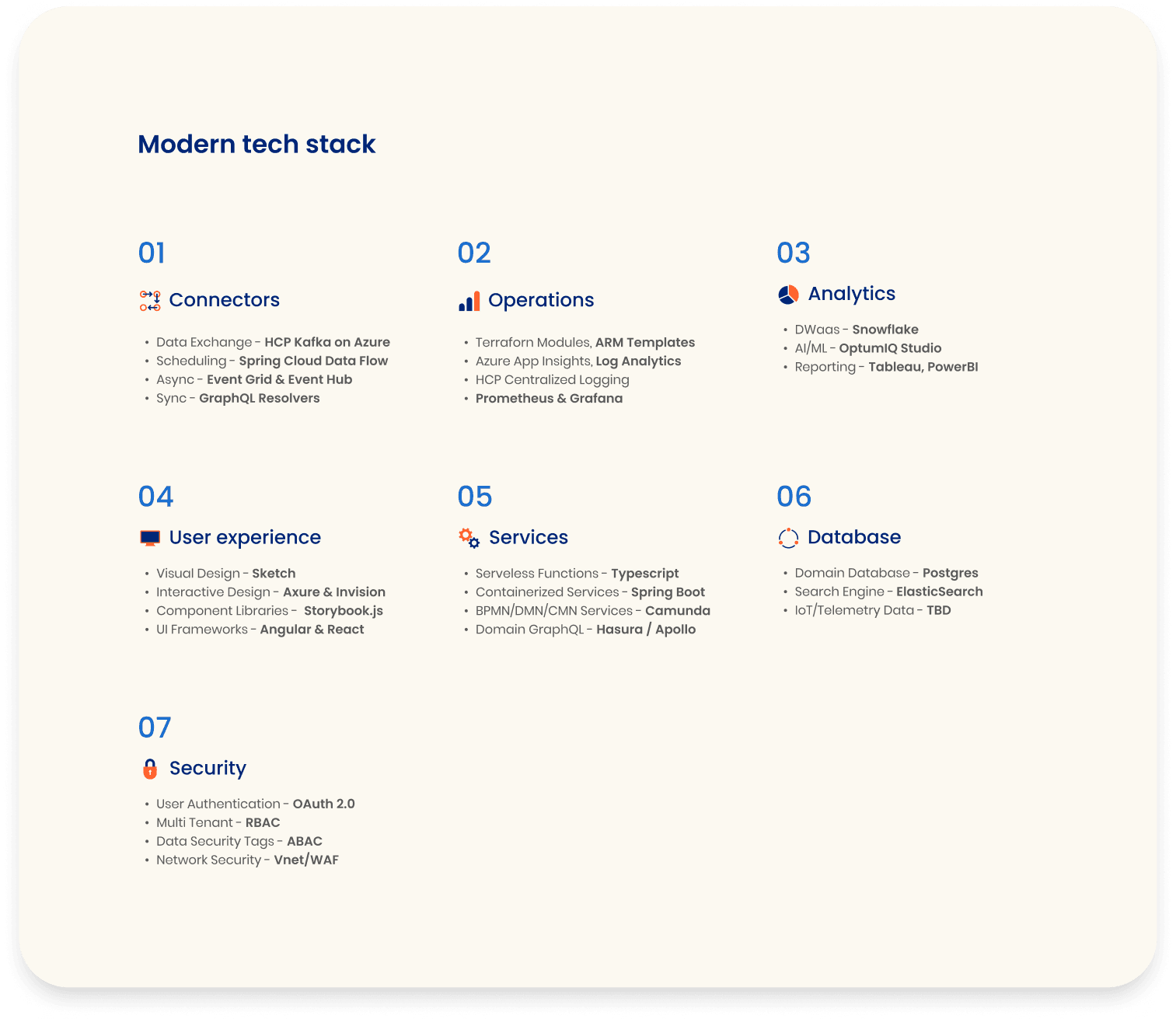
Outlines shared connectors, services, analytics, and security components that support all solutions without getting lost in technical jargon.
DESIGN JUSTIFICATION
Builds alignment across engineering teams and reinforces shared infrastructure over isolated builds.
Feature 3 of 6
Products page
Provides a searchable inventory of all microproducts, showing where each is used, its status, and how it contributes to the broader platform — supporting reuse during planning and implementation.

PLATFORM PAGE
Section 1 of 4
1.
System structure
Defines how product, business, and engineering collaborate within the platform.
DESIGN JUSTIFICATION
Creates a shared mental model across teams, reducing siloed development and reinforcing platform reuse.
PLATFORM PAGE
Section 2 of 4
2.
Reuse & ownership
Defines the three-layer model — Solutions, Microproducts, Core Platform — to structure scalable delivery.
DESIGN JUSTIFICATION
Defines how solutions and microproducts relate, helping teams work together more efficiently.
PLATFORM PAGE
Section 3 of 4
3.
Design system foundation
Highlights Netra as the shared design system used across implementations.
DESIGN JUSTIFICATION
Reinforces consistency across products with shared patterns across teams and products.
PLATFORM PAGE
Section 4 of 4
4.
Infrastructure at a glance
Outlines shared connectors, services, analytics, and security components that support all solutions without getting lost in technical jargon.
DESIGN JUSTIFICATION
Builds alignment across engineering teams and reinforces shared infrastructure over isolated builds.
Feature 3 of 6
Products page
Provides a searchable inventory of all microproducts, showing where each is used, its status, and how it contributes to the broader platform — supporting reuse during planning and implementation.
PRODUCT PAGE
Section 1 of 2
Making reuse visible
Centralized view of reusable microproducts across implementations.
DESIGN JUSTIFICATION
Surfacing real adoption data helps teams identify reuse opportunities before proposing new builds.

PRODUCT PAGE
Section 2 of 2
Searchable product inventory
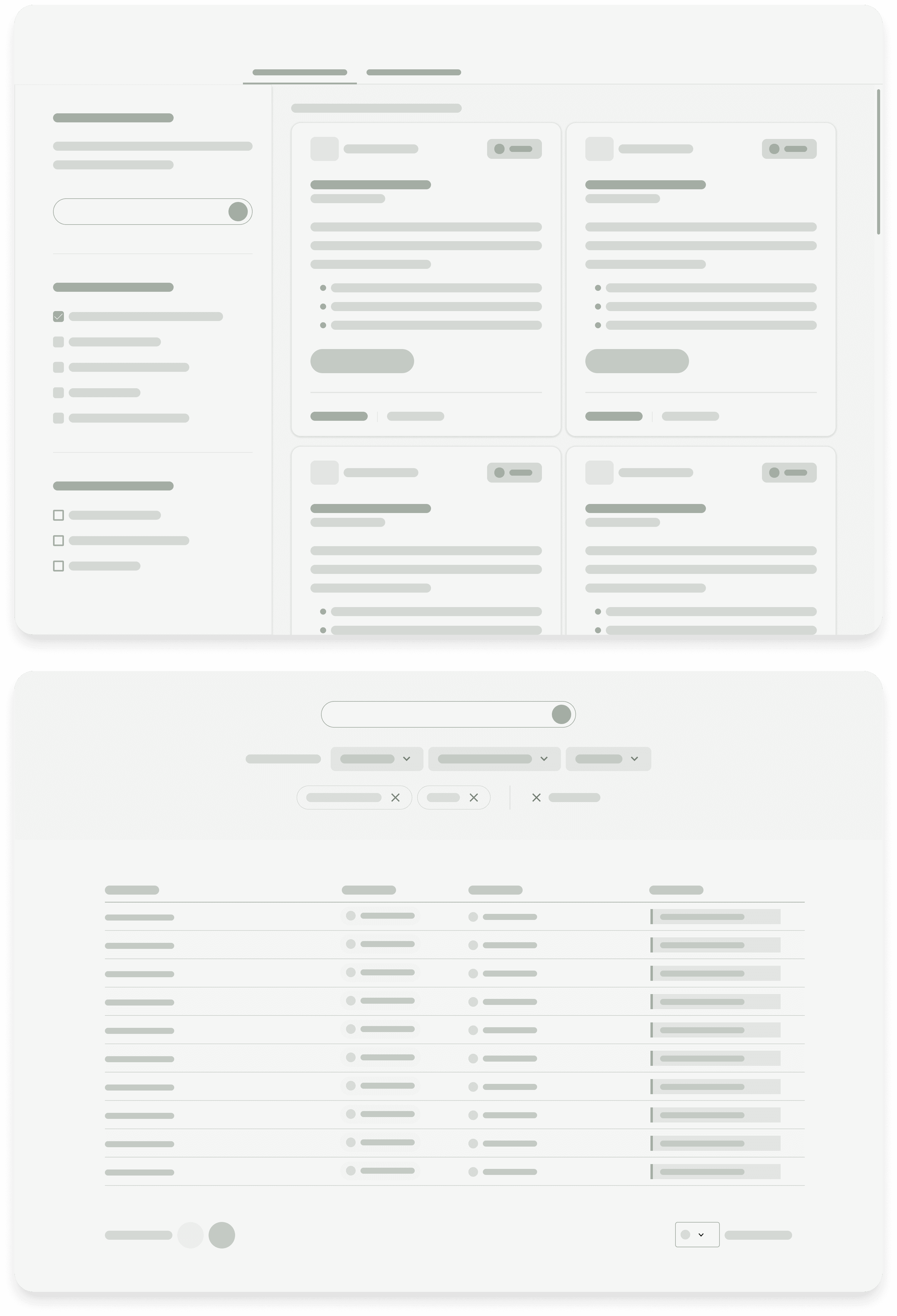
Filter by domain, lifecycle stage, and implementation to quickly locate existing capabilities.
DESIGN JUSTIFICATION
Makes discovery fast and reduces reliance on informal knowledge or outdated documentation.

Feature 4 of 6
Data domains
Maps available data domains across OCM, showing where data exists and is used — supporting integration planning.

PRODUCTS PAGE
Section 1 of 2
1.
Making reuse visible
Centralized view of reusable microproducts across implementations.
DESIGN JUSTIFICATION
Surfacing real adoption data helps teams identify reuse opportunities before proposing new builds.
PRODUCTS PAGE
Section 2 of 2
2.
Searchable product inventory
Filter by domain, lifecycle stage, and implementation to quickly locate existing capabilities.
DESIGN JUSTIFICATION
Makes discovery fast and reduces reliance on informal knowledge or outdated documentation.
Feature 4 of 6
Data domains
Maps available data domains across OCM, showing where data exists and is used — supporting integration planning.
DATA DOMAINS
Section 1 of 2
1.
Data inventory
Searchable list of data domains, availability and associated domains.
DESIGN JUSTIFICATION
Prevents duplicate integrations and clarifies ownership across teams.

DATA DOMAINS
Section 1 of 2
Data inventory
Searchable list of data domains, availability and associated domains.
DESIGN JUSTIFICATION
Prevents duplicate integrations and clarifies ownership across teams.
DATA DOMAINS
Section 1 of 2
Transparent Data Access
Filter by domain, line of business, and availability to understand implementation readiness.
DESIGN JUSTIFICATION
Improves implementation planning and reduces siloed data efforts.

DATA DOMAINS
Section 2 of 2
2.
Transparent Data Access
Filter by domain, line of business, and availability to understand implementation readiness.
DESIGN JUSTIFICATION
Improves implementation planning and reduces siloed data efforts.
Feature 5 of 6
Resources page
Centralizes platform roadmaps, governance artifacts, and documentation so teams and leaders reference the same source of information.

Feature 5 of 6
Resources page
Centralizes platform roadmaps, governance artifacts, and documentation so teams and leaders reference the same source of information.
RESOURCES PAGE
Section 1 of 2
1.
Shared platform resources
Consolidated roadmaps, governance guidelines, and supporting documentation in one place.
DESIGN JUSTIFICATION
Replaces scattered folders and outdated links with a single, reliable reference point.

RESOURCES PAGE
Section 1 of 2
Shared platform resources
Consolidated roadmaps, governance guidelines, and supporting documentation in one place.
DESIGN JUSTIFICATION
Replaces scattered folders and outdated links with a single, reliable reference point.
RESOURCES PAGE
Section 2 of 2
Resources by role
Curated views for leaders, product managers, and engineers.
DESIGN JUSTIFICATION
Reduces time spent searching for relevant information and improves cross-functional alignment.


RESOURCES PAGE
Section 2 of 2
2.
Resources by role
Curated views for leaders, product managers, and engineers.
DESIGN JUSTIFICATION
Reduces time spent searching for relevant information and improves cross-functional alignment.
Feature 6 of 6
Demos
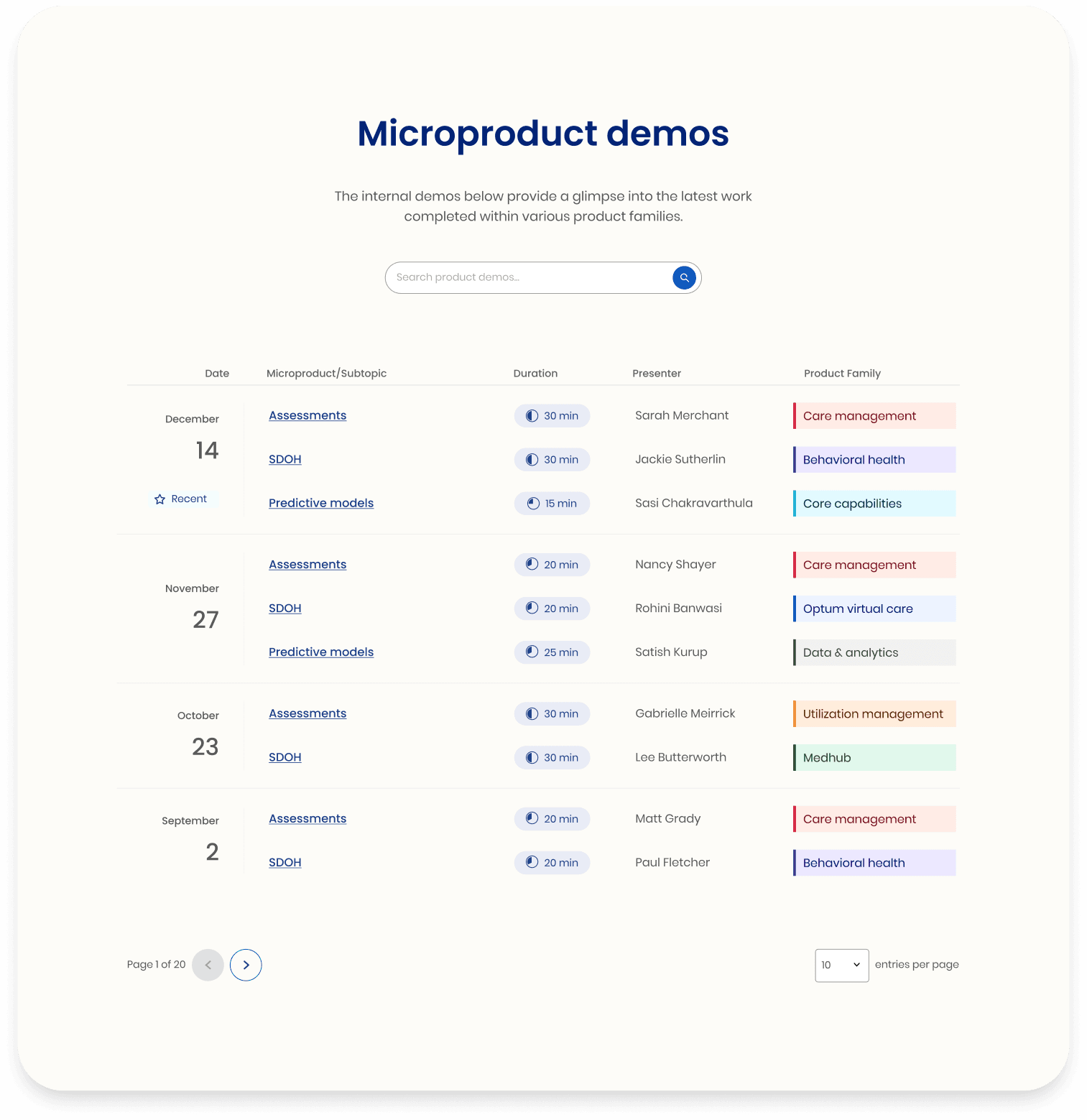
Organizes platform demos in one place, showing how shared capabilities come together within real clinical workflows.

Feature 6 of 6
Demos
Organizes platform demos in one place, showing how shared capabilities come together within real clinical workflows.
DEMOS PAGE
Section 1 of 2
1.
Capabilities in action
High-level demos show how shared capabilities work together within each product family to deliver cohesive clinical workflows.
DESIGN JUSTIFICATION
Grouping demos by product family shows how capabilities connect in practice, not as isolated features.

DEMOS PAGE
Section 1 of 2
Capabilities in action
High-level demos show how shared capabilities work together within each product family to deliver cohesive clinical workflows.
DESIGN JUSTIFICATION
Grouping demos by product family shows how capabilities connect in practice, not as isolated features.
DEMOS PAGE
Section 2 of 2
What exists & current status
Searchable log of microproduct demos across implementations, including status and contributing teams.
DESIGN JUSTIFICATION
A searchable demo inventory surfaces existing work and status, supporting collaboration and preventing duplication.
DEMOS PAGE
Section 2 of 2
2.
What exists & current status
Searchable log of microproduct demos across implementations, including status and contributing teams.
DESIGN JUSTIFICATION
A searchable demo inventory surfaces existing work and status, supporting collaboration and preventing duplication.
THE PROBLEM
Takeaways
Takeaways
As platforms scale, documentation alone doesn’t prevent duplication. Teams need a clear, usable system view with defined ownership and structure. This project showed that visibility directly changes planning behavior — and that design can reduce organizational friction, not just improve UI.
As platforms scale, documentation alone doesn’t prevent duplication. Teams need a clear, usable system view with defined ownership and structure. This project showed that visibility directly changes planning behavior — and that design can reduce organizational friction, not just improve UI.
PRODUCT OWNER
PRODUCT OWNER
“We can plan confidently, see where our work fits, and avoid overlap.”
“We can plan confidently, see where our work fits, and avoid overlap.”
BUSINESS LEADER
BUSINESS LEADER
“I can see the state of the platform at a glance, without digging through reportsl.”
“I can see the state of the platform at a glance, without digging through reportsl.”
HOSPITAL ADMINISTRATOR
HOSPITAL ADMINISTRATOR
"I can see how the platform supports care across the workflow .”
"I can see how the platform supports care across the workflow .”


